
Lifting Up Worker Voice on Technology: UNITE HERE’s National Technology Program
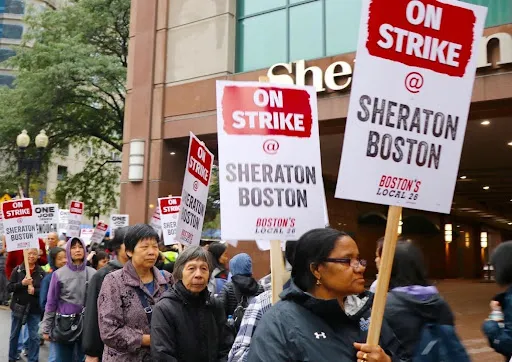
Beginning in 2018, UNITE HERE, under the leadership of then-President D Taylor made a substantial commitment to facing the challenges that technology poses for the hospitality industry. This commitment continues under Taylor’s successor, Gwen Mills. The union made that commitment because they understand technology not as a neutral or positive force in the world, but as one that reflects the perspective and goals of its creators and implementors. For technology to serve the needs of frontline workers, those workers need to be part of both the development and the implementation process.
The labor movement has long understood that the only power that ordinary people have is collective action—whether on the picket line or at the ballot box. Harnessing workers’ power with regard to technology means educating and mobilizing working people to advocate for their own (and their co-workers’) interests. Over the past eight years, UNITE HERE has used collective bargaining and worker mobilization to create a process for midcycle bargaining when employers want to implement new technology. The union has also worked with academic researchers to understand workers’ experience of existing technologies and to develop training initiatives to improve those experiences. Finally, UNITE HERE has partnered with tech developers to help advance worker-centered technologies. These three strategies work in tandem to advance a vision of technology that supports and uplifts humans at work rather than oppress and replace them.
The following paper details the theory and achievements of the program beginning with the decision to fight for novel contract language in the 2018 contract cycle. Rather than bargaining over specific technologies, the contract language sets up a process to negotiate whenever the employer intends to implement new technology while the contract is in effect, a process we call, “midcycle bargaining.” Over the past seven years, the union has used this midcycle bargaining to negotiate over one hundred times.
Reflecting on first few years of the program, Mills summarized:
We live in a time when the richest people in the world are looking to further consolidate their wealth and power, and they are using tech to do it. If you listen to Silicon Valley, tech is always perfect and inevitable, and those of us who raise concerns are anti-progress. Almost a decade ago, President Taylor recognized that without worker input, tech innovation was just going to line the pockets of billionaires at the expense of normal working people.
We still have a long way to go to achieve technological innovations that uplift all humanity rather than benefit a few, but I believe that we have a model of how to get there. As our program evolves, and it must, because technology is evolving, we are holding on to that core vision—workers must be part of the design and implementation of technology.
Read the full report HERE